Marfa Gavrilovna Tiverzina
Doctor ZhivagoMarfa Gavrilovna Tiverzina is a railway-worker’s widow whose private history of loss and resistance gives force to her public defiance. Mother to Kuprian Tiverzin and a protector of Pasha Antipov, she joins a November demonstration despite her son’s efforts to dissuade her; when dragoons attack the crowd, her immediate concern is finding Pasha. Her passage through the episode links domestic care to political violence without reducing either to an abstraction.
Family and Early Loss
Marfa is introduced as the mother of Kuprian Tiverzin, a railway worker and revolutionary. Her marriage to Savelii Nikitich, a mechanic, began after she rejected Piotr Khudoleiev, then a dashing young workman who had courted her. The choice becomes a lasting fault line in the household’s history: after Savelii’s death, Khudoleiev tries to win her again, and she refuses him a second time.
Savelii had been burned to death in the railway crash of 1888. The loss is part of a wider family history of railway labor and danger. Later, Marfa travels third class with two daughters-in-law, and the narrative identifies her as the widow of a man who died in a railway accident. Beside the body of another man who has died violently, she stands back from the crowd and seems to compare the two deaths, distinguishing Savelii’s fatal accident from a death she associates with wealth and mental illness. Her reflection places her own bereavement alongside a stranger’s fate, while making clear that she does not regard all deaths as alike.
A Household of Protection and Grievance
After Pasha’s father is arrested as one of the strike organizers, Pasha goes to live with the Tiverzins. Marfa’s home thus becomes part of the network of care sustaining a child whose family has been disrupted by political repression. She is also present in the story of Yusupka, the son of Gimazetdin, the janitor at the Tiverzins’ tenement. Kuprian has taken the boy under his wing, a connection that helps explain the hostility directed at him by Khudoleiev, who is already embittered by Marfa’s rejection.
Khudoleiev’s history reveals how his resentment has become entangled with Marfa’s choices. He once pursued her and was refused; after Savelii’s death, he renewed his suit and was again rejected. He then turned to drinking and rowdiness, blaming the world for his misfortunes. The narrative does not make Marfa responsible for his conduct: it records her refusal as a fact of her life, while locating the violence of his response in his own grievance. Her household, marked by work, bereavement, and care for vulnerable boys, stands in contrast to the foreman’s attempt to convert disappointment into punishment of others.
The Demonstration and the Attack
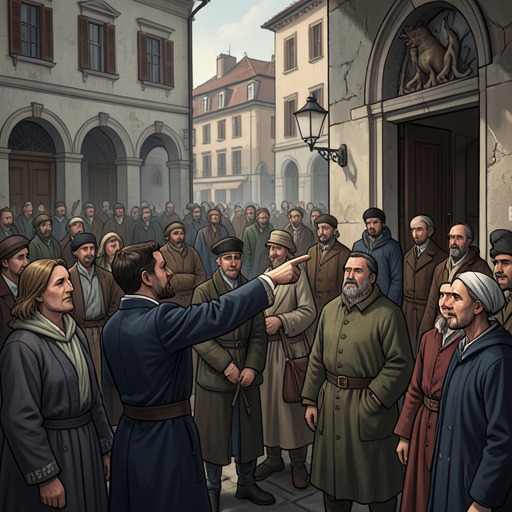
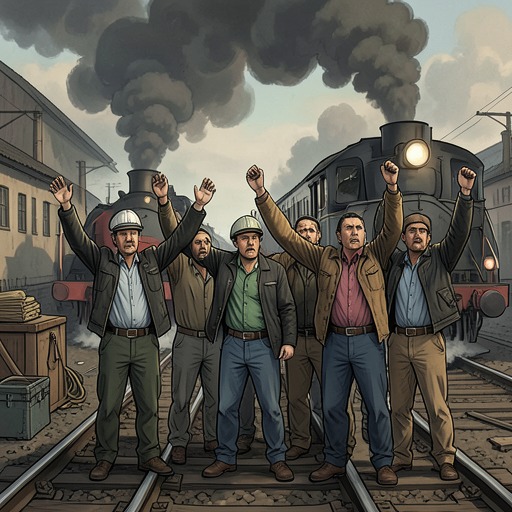
After the October Manifesto, revolutionary organizations call for a large demonstration, but their organizers quarrel and withdraw one by one. When they learn that crowds have gathered anyway, representatives are hastily sent to lead them. Despite Kuprian’s effort to dissuade her, Marfa joins the demonstrators; the sociable Pasha accompanies her. Their participation is not presented as the result of an orderly campaign. It begins amid confusion over who will lead the march, as a crowd forms and proceeds through Moscow.
The attack turns the demonstration into a scene of sudden dispersal. Dragoons charge the procession, and within minutes the avenue is nearly empty as people flee into side streets. The snow and the red traces left in the street frame the aftermath of the massacre, but Marfa’s response is sharply particular: she runs from side to side, her shawl knocked back, calling for Pasha as the horsemen return. A dragoon’s whip has struck her back. She has hardly felt the blow through her thick quilted coat, yet she shakes her fist at the retreating riders, outraged that they have dared to strike an old woman in public.
Pasha, Survival, and Political Anger
Pasha had been with Marfa throughout the demonstration, entertaining her by imitating the last speaker at the meeting. When the dragoons charge, however, he disappears in the confusion. Marfa first sees only the violence and the boy’s absence; after searching anxiously, she spots him across the street, trapped with other bystanders in a recess between a grocer’s shop and a private stone house. A mounted dragoon has hemmed them in, making his horse rear and turn among the frightened people as if performing for an audience. When he sees the other riders return, he spurs the horse away and rejoins the file.
Once the crowd disperses, the frightened Pasha rushes back to Marfa, unable to utter a sound until he reaches her. Their reunion ends the immediate search but not the anger the attack has stirred. On the way home, Marfa denounces the dragoons as murderers and condemns their refusal to accept the freedom proclaimed by the Tsar. She is furious not only at the riders but at the world around them, which, in her view, takes people’s words and turns them inside out. Her anger also briefly turns toward Kuprian: in her temper she blames his bungling and fumbling for the troubles. The episode leaves her neither as a detached political observer nor simply as a maternal figure. Her participation, injury, fear for Pasha, and angry return home make political violence inseparable from the concrete obligations of protecting someone in her care.